Give another writer something useful to reference: a specific explanation, well-sourced evidence or a documented example. Make it easy to find, check and link to. That gives your work a reason to be linked to, mentioned or cited without requesting a placement. Each is a different outcome; none is guaranteed.
Backlinks are an established part of off-page SEO, but the value of being referenced extends beyond a clickable link. Relevant mentions and citations can help build recognition and credibility around your expertise. I see that wider authority-building work as part of preparing for GEO and AI search, alongside traditional SEO.
Google’s guidance on generative AI search explains that its AI features rely on core Search ranking and quality systems and can draw on what is said across the web. This supports investing in useful work and an authentic reputation, rather than treating each mention as a guaranteed boost to AI visibility. A backlink, an unlinked mention and a bibliographic citation do not have interchangeable SEO effects.
Start with a question your audience needs answered, then give another writer a reason to use your answer. A clear comparison, a well-defined local example or a transparent piece of research can contribute something that a generic overview does not.
Before commissioning more content, examine one existing page. Can someone identify its useful finding, verify the evidence and link directly to the relevant section? Improving those three things gives you a practical starting point, even if no backlink follows.

Start with the person who needs a source
A content brief normally identifies the intended reader. I would also identify who publishes information for that reader. A restaurant owner needs practical guidance; a hospitality researcher may need a clearly defined account of the local market. One page can help both, provided the relevant detail is there.
Read the reports, guides and resource pages that already cover the subject. Follow their references. Look for an outdated table, an explanation without local context, a claim with no source, or a recurring question that nobody answers clearly. This gives your research a purpose before you choose a format.
What does the reader or writer need to establish?
What evidence or explanation can you supply?
Can someone check, find and reference it?
A defined market gives a broad topic something concrete to discuss. My Hong Kong restaurant SEO guide, for example, appears in the bibliography of a 2025 hospitality conference paper by PolyU researchers. It is a citation to a local resource, not evidence that the local angle alone earned it.
Stay within subjects your business understands. Google’s people-first content guidance emphasises serving an intended audience and adding original information or analysis. I would want a page to help that audience even if it never earned a backlink.
Original data is valuable. Original analysis matters too.
Strong original data gives another publisher a particularly clear reason to reference you: you are the source of a finding they cannot obtain elsewhere. A well-designed test, survey or documented project can make your page valuable beyond its initial audience. The value still depends on the quality and relevance of the evidence, not simply on being first to publish it.
You do not need a research budget to make a useful contribution. If you cannot collect new data, help people use existing research better. Compare compatible findings, explain where studies disagree, or work through what the evidence means for a specific audience or decision.
A comparison can reveal a pattern that separate tables leave unclear. Applying a study to a different business situation can help readers ask better questions, provided the differences in tasks, participants and context remain visible. Even a specialist explanation can be useful: Mitosis’s educational content hub included a link to my decentralised-search article among its sources.
The distinction is between repeating a finding and making it more useful. Choose a format around the contribution you can support:
| What you can contribute | What makes it useful | What to disclose |
|---|---|---|
| A focused test | A result someone can examine or repeat | Setup, timeframe and limitations |
| A public-data comparison | An answer that the source tables do not make obvious | Sources, definitions and calculations |
| A practical case study | A decision explained through a real situation | Baseline, alternatives and attribution limits |
| A specialist explanation | Clarity on a difficult or overlooked question | Primary evidence and your interpretation |
| A working tool or template | Help with a recurring task | Assumptions and a worked example |
Keep the original sources visible, and identify any calculations or interpretations you add. When studies use different populations, definitions or timeframes, explain the differences instead of combining their numbers into a misleading comparison.

Make the evidence easy to check and cite
Aytekin Tank’s Forbes contributor article on solopreneurship links to my AI and solopreneurship explanation while discussing productivity. My page is a synthesis, not the original study. Keeping the research source visible helps readers follow that distinction.
- State the finding clearly. Explain what happened or what the evidence shows before discussing its implications.
- Keep the conditions beside the claim. Include the date, population, measurement and important exclusions.
- Link to the original source. Let someone follow the evidence beyond your summary.
- Make visuals usable as evidence. Label the units, show the source and provide the essential finding in readable text.
A descriptive heading and a section link can help a writer send readers directly to the relevant passage. Stable URLs, named authors and accurate dates make the resource easier to identify later. Keep the core evidence accessible if broad public reference is your objective, rather than putting the only useful material behind an email form.
Similarly, Writify AI uses a nofollow link to my older explanation of Google’s AI-content and spam guidance. It still gives readers a route to the source; I would not use it to claim a ranking gain.
Being cited is also a reason to review a claim, not a reason to stop checking it. An old statistic can circulate because it is convenient. A careful update should explain its actual scope instead of using the citation as proof that the claim must be right.
Without outreach still means helping people find it
A useful page needs a route to its audience. Connect it to relevant guides, articles and service pages on your own website. Google recommends that every page you care about receive a link from another page on your site. Descriptive internal links also tell readers why the resource belongs in their journey.
Check that the page is accessible, returns a successful response and contains indexable content. Those are part of Google Search’s technical requirements; meeting them does not guarantee indexing or rankings.
Beyond search, share the useful finding through channels where you already contribute. A newsletter can explain the result; a social post can show the comparison. In a relevant community, answer the question first and link when the resource adds something and the rules permit it.
This is distribution, without asking for a backlink. Legitimate outreach can also lead to independently chosen references. My experience is not an argument against introducing useful work to relevant people. It is an alternative to making link requests the centre of the content process.
Keep that distinction from link schemes clear. Google’s link-spam policy covers practices such as buying links for ranking purposes, excessive exchanges and automated link creation. Publishing a useful resource does not require those arrangements.

Keep the reference useful after publication
My attention-span article is listed in the bibliography displayed on ResearchGate for a paper about AI in Russian school education. That is a bibliographic citation; I have not confirmed a clickable outbound link. The screenshot retains the old blog address, which now redirects to the updated article.
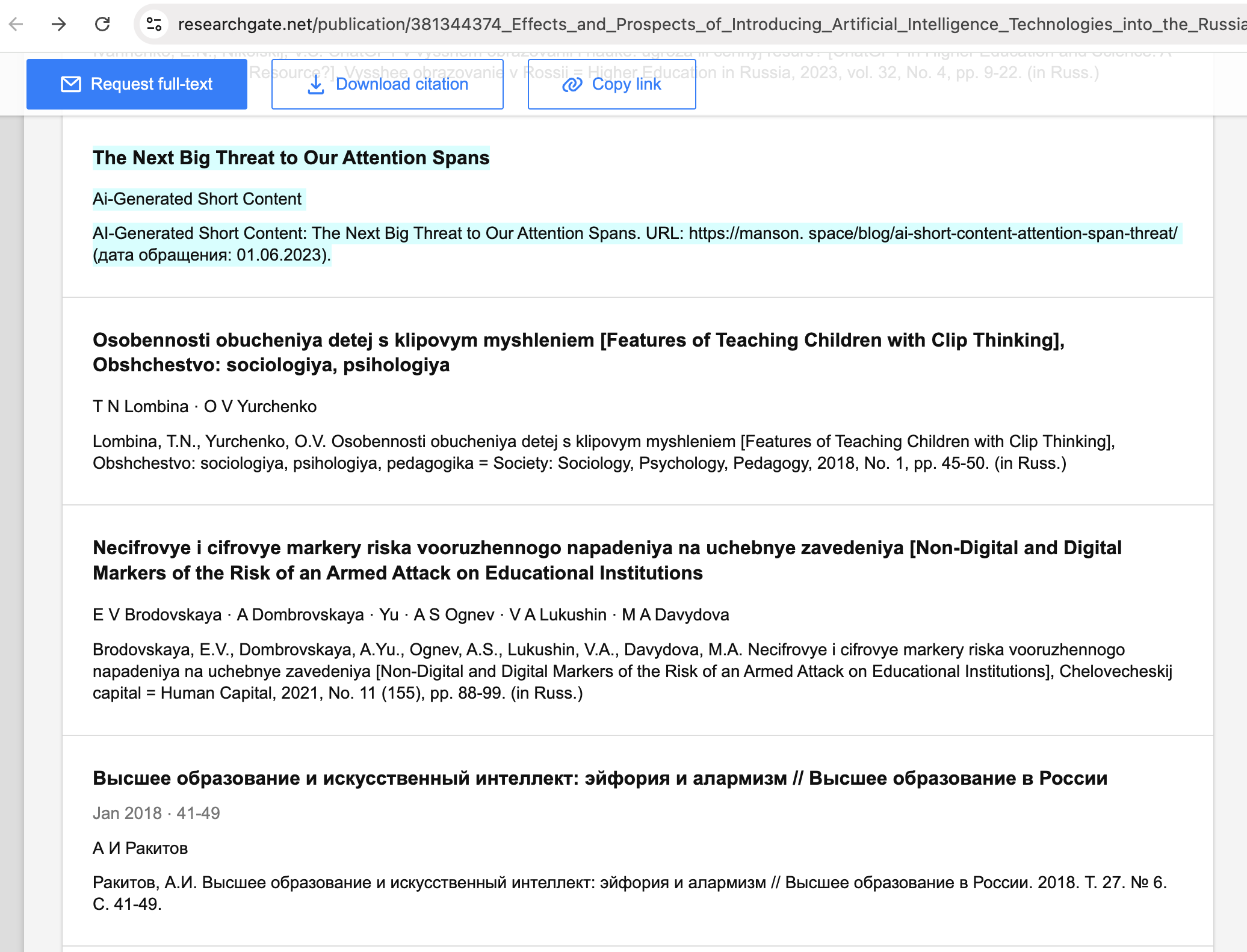
Before rewriting a page that others use, inspect the cited passages. Correct errors and replace outdated evidence while keeping enough context for readers to understand the subject. Do not preserve an inaccurate claim merely because it has been cited.
If the URL must change, use a direct server-side permanent redirect to the relevant replacement. Google’s migration guidance cautions against redirecting unrelated old pages to the homepage. Check linked downloads and images too: references may point to those files rather than the article.
Then use the referring context to improve your next brief. Was the writer using local context, a comparison or an explanation? Record that separately from referral traffic, search performance and qualified enquiries. Include pages that earned no references in your review, so a few successful examples do not become a misleading success formula.
Start by improving one useful page
For a small team, I would begin with an existing article in an area of genuine expertise. Define the missing contribution, check what evidence you can provide, and improve that part of the page before commissioning a larger content programme.
A brief you can use
- Reader’s question
- What should this page help someone understand or do?
- Potential reference
- Which explanation, finding or example could another writer use?
- Evidence needed
- What sources, observations or calculations will support it?
- Discovery route
- Which existing pages and channels will introduce it?
- Maintenance trigger
- What change would make the content need another review?
My earlier articles acquired uses I had not anticipated. I cannot choose which publication will reference the next one. I can make the work specific, accurate and accessible enough to deserve consideration, and useful to my own audience whether a link follows or not.
Research content that gives people a reason to reference it
I help businesses identify audience questions, assess the evidence and turn useful findings into content briefs and articles. We can start with an existing page and work out what would make it a stronger resource.
Discuss your content research